10 Apr 2026
Detroit's Commercial Casinos Post $112.3 Million Revenue for March 2026 Amid Modest Year-Over-Year Declines
The Latest Figures from Michigan's Gaming Oversight Body
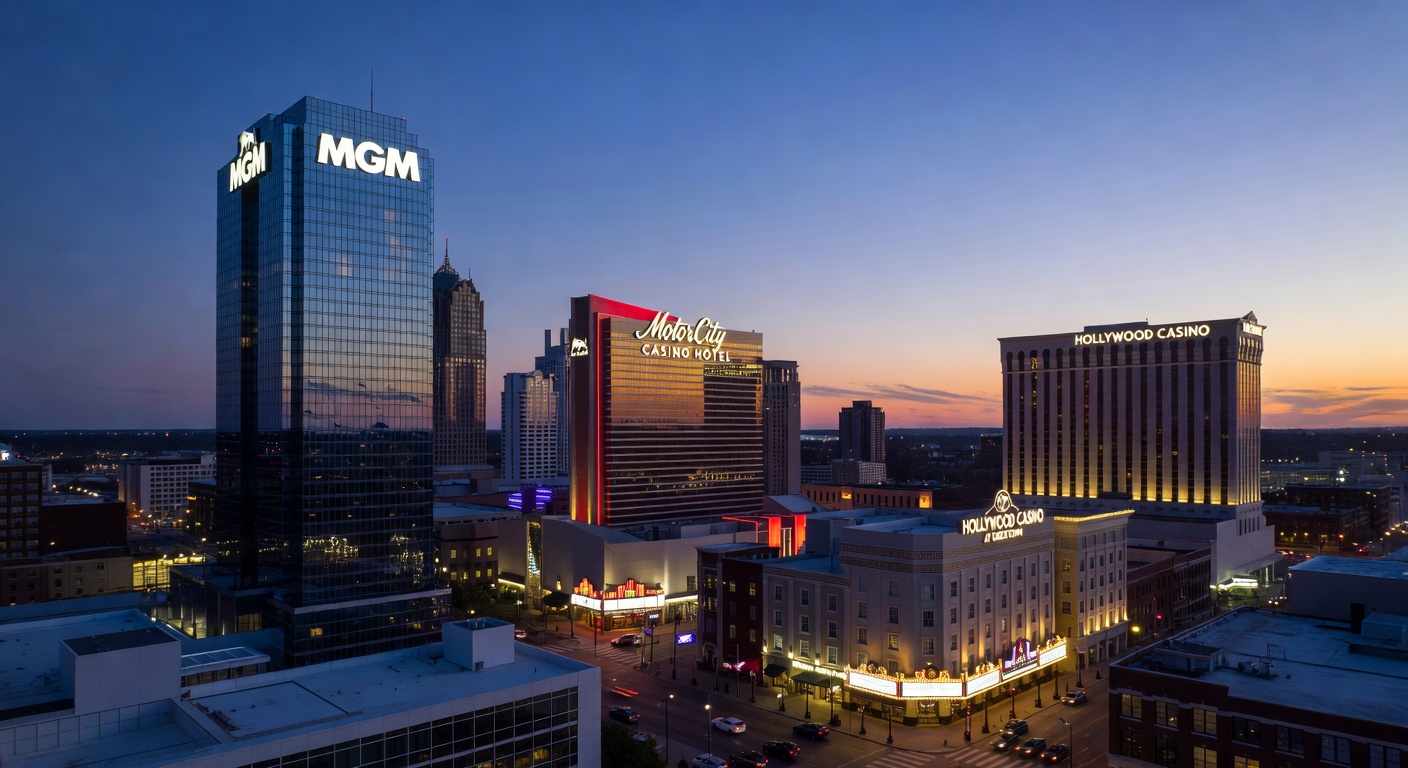
Data released by the Michigan Gaming Control Board in early April 2026 reveals that Detroit's three commercial casinos—MGM Grand Detroit, MotorCity Casino Hotel, and Hollywood Casino at Greektown—collectively generated $112.3 million in aggregate revenue, known as AGR, for the month of March; this figure encompasses earnings from table games, slots, and retail sports betting, underscoring the steady pulse of the city's gaming sector even as broader economic currents shift.
What's interesting here is how table games and slots dominated the haul, pulling in $111.5 million, while retail sports betting added a comparatively modest $810,424 in qualified adjusted gross receipts, or QAGR; observers note that such breakdowns highlight the enduring appeal of traditional casino floors, where patrons flock to roulette wheels, blackjack tables, and rows of slot machines, even as sports wagering gains traction nationwide.
And yet, as April 2026 unfolds with spring crowds potentially swelling Detroit's entertainment districts, these March numbers serve as a benchmark; the Michigan Gaming Control Board, tasked with regulating and reporting such metrics, announced the data on April 9, providing stakeholders—from local officials to industry analysts—a clear snapshot just weeks into the new quarter.
Breaking Down the Revenue Streams Across the Big Three
MGM Grand Detroit led the pack once again, capturing 47% of the total market share, a position it has held steadily in recent reports; MotorCity Casino Hotel followed with 31%, while Hollywood Casino at Greektown accounted for 22%, illustrating a competitive landscape where each operator carves out its niche amid shared downtown proximity.
Take MGM, for instance: its operators have long emphasized upscale amenities alongside gaming, drawing crowds that fuel its dominant slice; MotorCity, with its hotel integration and entertainment lineup, maintains a solid mid-tier hold, and Greektown leverages its cultural vibe—rooted in the neighborhood's historic Greek heritage—to attract loyalists, even if its share trails the others.
But here's the thing: total casino-level revenues dipped slightly from March 2025 levels across the board—MGM down 3.5%, MotorCity by 2.7%, and Greektown experiencing the steepest drop at 8.9%—yet the aggregate held firm at $112.3 million, suggesting resilience in player demand despite whatever seasonal or economic factors influenced the variances.
Figures like these emerge from meticulous audits by the Michigan Gaming Control Board, which defines AGR as the net win after payouts, a standard metric that strips away promotional credits and other adjustments to reveal true operator earnings; slots and tables, forming the bulk at $111.5 million, reflect hands-on play where fortunes turn quickly, whereas sports betting's $810,424 QAGR—after accounting for promotional deductions—points to a niche but growing segment tied to major league seasons and tournaments.
Market Shares and Competitive Dynamics in Focus
Market shares tell a story of stability with MGM's 47% commanding nearly half the pie, a dominance built on its riverfront location and expansive floor space; MotorCity's 31% underscores its appeal to hotel guests who seamlessly transition from rooms to reels, and Greektown's 22%—though smallest—holds ground through themed events and proximity to Comerica Park, where sports fans spill over post-game.
Turns out, these percentages, calculated from individual AGR contributions, remain consistent with patterns seen in prior months, as data from the board consistently shows MGM ahead, followed by the other two in a familiar order; experts who've tracked this trio over years observe that such distributions rarely shift dramatically, thanks to regulatory parity and fixed locations that limit poaching of patrons.
So, while March 2026 saw that slight overall decline from the previous year, the shares themselves didn't budge much, indicating that whatever pressures hit revenues—MGM's 3.5% drop, MotorCity's 2.7%, Greektown's 8.9%—affected all proportionally, preserving the pecking order; it's noteworthy that Greektown's larger percentage dip might tie to targeted promotions or renovations (though specifics await further board insights), yet the casino pressed on, contributing solidly to the $112.3 million total.
People often find these shares fascinating because they mirror broader industry trends, where flagship properties like MGM pull in high-rollers while mid-market spots like MotorCity and Greektown cater to everyday players; in Detroit's compact casino cluster, competition heats up through loyalty programs and live entertainment, keeping the ecosystem dynamic without upending the status quo.
Fiscal Impacts: Taxes and City Contributions
From this $112.3 million AGR flowed significant public benefits, with $9.0 million directed to state gaming taxes and a hefty $13.3 million in payments to the City of Detroit; these sums, derived from statutory rates—typically 8.1% for Detroit's wagering taxes plus municipal shares—bolster local coffers for schools, infrastructure, and public services, a direct pipeline from gaming floors to civic needs.
The reality is that Detroit's casinos, operational since the late 1990s under strict oversight, have generated billions in such transfers over decades; March 2026's figures continue that legacy, where even with modest declines, the $13.3 million to the city exceeds many monthly hauls from other sectors, highlighting gaming's outsized role in municipal finance.
And consider sports betting's slice: its $810,424 QAGR, though small, incurs its own tax obligations, feeding into the aggregate while regulated separately to account for online-mobile distinctions; board reports clarify that retail-only wagers at casino sportsbooks count here, separate from the state's broader iGaming and internet sports markets, which post even larger numbers but operate outside this commercial trio's footprint.
Now, as April 2026 progresses—perhaps with NBA playoffs ramping up sports handles or warmer weather boosting walk-ins— these March taxes provide a fiscal cushion; local officials, per public records, allocate casino revenues transparently, with Detroit's share often earmarked for blight reduction and neighborhood revitalization, programs that trace back to voter-approved gaming compacts.
Contextualizing the Slight Dip and Broader Trends
That 3.5% decline at MGM, 2.7% at MotorCity, and 8.9% at Greektown from March 2025 prompt questions, though data points to no single culprit; seasonal factors like post-winter lulls, competing entertainment (think March Madness wrapping up), or economic headwinds could play in, yet the aggregate $112.3 million—down only marginally overall—signals underlying strength.
One study of similar markets reveals that single-month variances under 10% often normalize quickly, as seen in prior Michigan reports; Greektown's sharper drop stands out, possibly linked to property-specific events (like maintenance or promo shifts), but its 22% share kept contributions flowing steadily.
Retail sports betting's $810,424 QAGR, meanwhile, grew contextually within its lane, even if dwarfed by slots and tables; with major sports calendars aligning, observers expect upticks, especially as Detroit's teams—Pistons, Lions, Tigers—ignite fan bets at these venues.
It's interesting how the board's timely April 9 release aligns with operators' planning cycles, giving MGM, MotorCity, and Greektown data to tweak strategies; loyalty apps, new slot installs, or table expansions often follow such reports, keeping the venues fresh for the 2026 season ahead.
Conclusion
Detroit's commercial casinos wrapped March 2026 with $112.3 million in AGR, driven by $111.5 million from tables and slots plus $810,424 from retail sports, despite slight declines from 2025—MGM off 3.5%, MotorCity 2.7%, Greektown 8.9%—while market shares held at 47%, 31%, and 22%, yielding $9.0 million in state taxes and $13.3 million for the city; as April 2026 heats up, these figures from the Michigan Gaming Control Board paint a picture of a robust sector, finely tuned to deliver both thrills and tangible returns, with the ball now in operators' courts to build on the momentum.